Almost every article about booking flights repeats the same folklore: book on a Tuesday, book exactly 54 days out, clear your cookies, search in incognito. These claims get repeated because they are easy to write, not because anyone checked them recently.
We are in an unusual position to check. Our price scouts poll live fares on real routes around the clock, and every observation gets logged. Between 6 June and 9 August 2026 that produced 13,799 priced observations across 55 routes — not estimates, not scraped averages, but the actual price a traveller would have been quoted at that moment.
So we went looking for the Tuesday effect. We found one — pointing the other way.
Finding 1: the weekday effect is real, and backwards
Fares differ enormously between routes — a Zurich–Istanbul hop sits around $80, a Tokyo–Toronto run around $845. Averaging raw dollars across them would measure which routes we happened to scan, not the effect we care about. So every observation below is indexed to its own route's median: a $40 move on an $80 route counts the same as a $300 move on a $600 one.
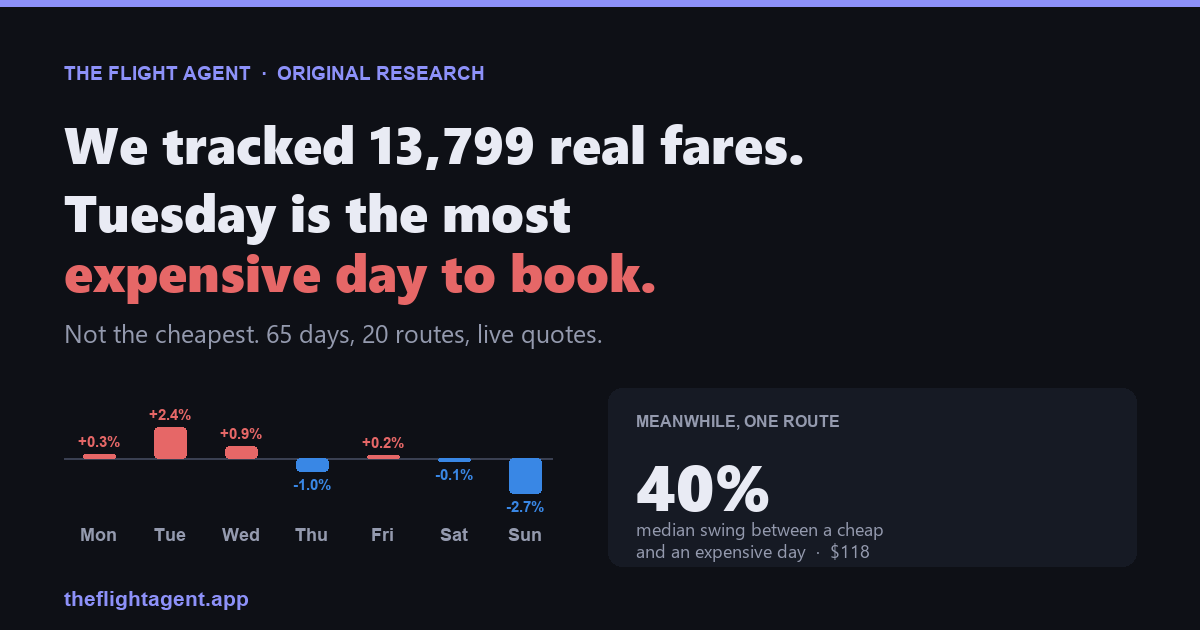
We expected this to dissolve under testing. It did not. We shuffled the weekday labels across all 13,201 observations 2,000 times and re-measured the spread each time: the reshuffled data produced a median spread of 0.19%, and exceeded 0.48% in only 5% of runs. Our observed 5.25% never came up once (p < 0.0005). Whatever is happening here, it is not chance.
So the weekday effect is real — it simply runs opposite to the advice everyone repeats. We would still caution against inverting the folklore and declaring Sunday the new Tuesday. Nine weeks of one summer on twenty routes establishes that the effect existed in this window, not that it is a permanent law of airline pricing. What it does establish is that the Tuesday rule has no support in current data, and anyone still repeating it is working from something other than measurement.
The best weekday saves you 5%. The route you are watching can move 40% while you wait for it. One of those is worth optimising.
Finding 2: the same flight route swings 40%
Here is the part that surprised us. The weekday effect is worth 5% — but timing in general is worth far more than that. Watch a single route for two months and it does not hold still.
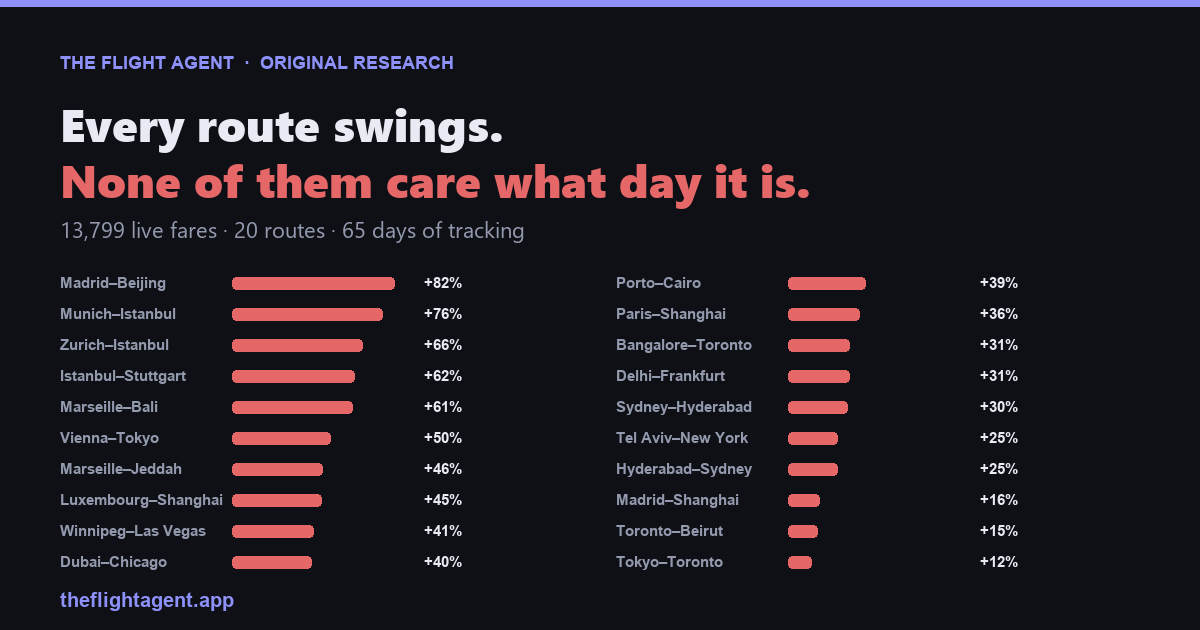
To measure this honestly we ignore the extremes. Every route has a handful of freak quotes: one Dubai–Chicago observation came back at $1,856 against a typical $574, and building a headline on six outliers would be dishonest. Instead we use the 10th-to-90th-percentile band — the range an ordinary traveller actually runs into.
| Route (airport pair) | Observations | Cheap (p10) | Median | Expensive (p90) | Spread |
|---|---|---|---|---|---|
| Madrid → Beijing MAD–PEK | 884 | $323 | $383 | $590 | +82% |
| Munich → Istanbul MUC–IST | 861 | $74 | $86 | $130 | +76% |
| Zurich → Istanbul ZRH–SAW | 861 | $67 | $80 | $112 | +66% |
| Marseille → Bali MRS–DPS | 598 | $537 | $763 | $864 | +61% |
| Vienna → Tokyo VIE–NRT | 703 | $511 | $628 | $765 | +50% |
| Paris → Shanghai CDG–PVG | 1,519 | $440 | $459 | $597 | +36% |
| Tel Aviv → New York TLV–NYC | 884 | $577 | $629 | $720 | +25% |
| Tokyo → Toronto HND–YYZ | 504 | $785 | $845 | $880 | +12% |
Finding 3: the cheap moment is rarer than you think
If prices move that much, the obvious question is how often the good price is actually available. We counted, for each route, the share of observations sitting within 10% of that route's cheapest recorded fare.
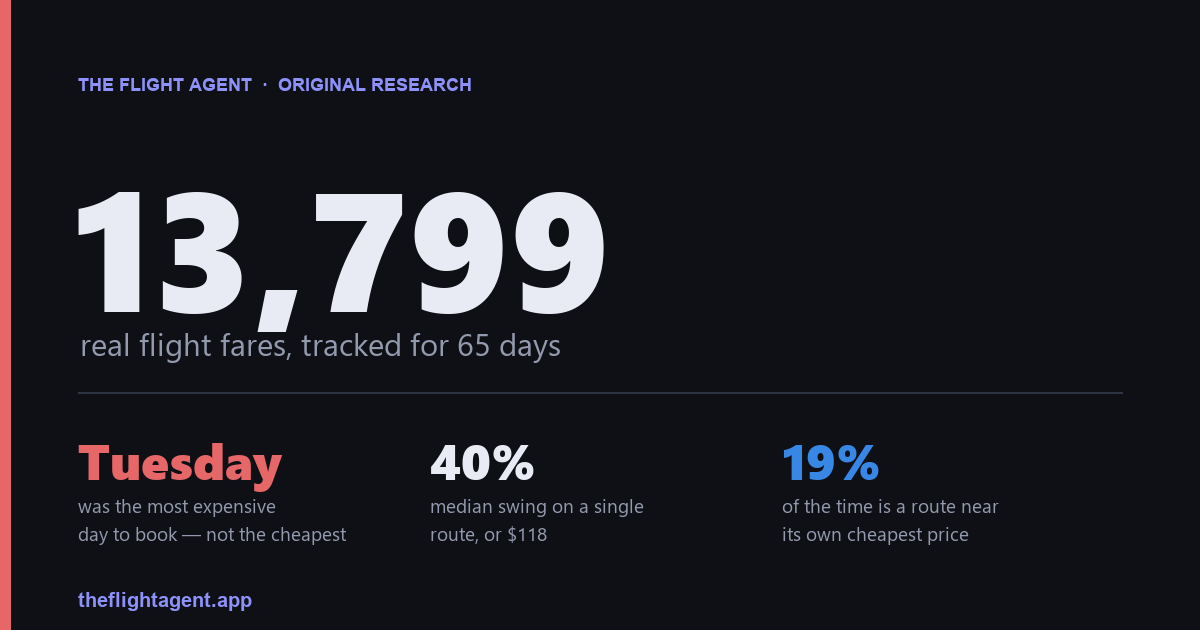
The median route was near its own floor just 19% of the time. On several it was far rarer than that: Vienna–Tokyo and Luxembourg–Shanghai each spent about 0.1% of the window near their cheapest price. That is roughly one hour in six weeks.
This is the finding that ties the other two together. The reason weekday rules fail is not that timing does not matter — it is that the cheap window does not care what day it is. It opens irregularly, it is narrow, and if you check on a schedule you will usually miss it.
You cannot catch a 40% swing by checking on Tuesdays. You catch it by not checking manually at all.
What we would actually tell a traveller
- Drop the weekday rule. Book when the price is good, on whatever day that happens to be. Waiting until Tuesday is as likely to cost you as save you.
- Judge the price against its own route. "$400 is cheap" is meaningless. "$400 on Paris–Shanghai, where the typical fare is $459 and the cheap end is $440" is a decision you can make.
- On volatile routes, patience pays and precision matters. Madrid–Beijing moves $266 between its cheap and expensive end. Tokyo–Toronto moves $94. Know which kind of route you are on before deciding to wait.
- Automate the watching. The cheap window is narrow and irregular. That is a machine's job, not a human's.
Method, and what this study cannot tell you
Every fare our scouts retrieve is logged with its price, route, airline, departure date and timestamp. This analysis covers 6 June – 9 August 2026: 14,123 priced observations, of which 13,799 survived normalising inconsistent airport labels. We then restricted cross-route comparisons to the 20 routes with at least 100 observations, leaving 13,201 observations in the analysed pool. All cross-route figures are indexed to each route's own median so that route mix cannot drive the result. Volatility uses the 10th–90th percentile band rather than minimum-to-maximum, because the extremes are driven by a handful of outlying quotes.
One route (Melbourne–Singapore) was excluded by a data-quality gate: 43% of its 114 observations came back at exactly the same price, which indicates a cached quote rather than a tracked market, and made its percentiles meaningless. No other route in the set exceeded 26% on that measure. The weekday result was tested with a 2,000-iteration permutation test, shuffling day labels and re-measuring the spread; the observed 5.25% sits far outside the null distribution (95th percentile 0.48%).
We wanted to answer the biggest question in flight booking — how far ahead should you book? — and our data cannot yet answer it honestly. Only 29% of the flights we track were observed at more than one lead time, with a median span of 15 days. Comparing our 3-week-out prices to our 8-week-out prices would mostly be comparing different flights, not the same flight approaching departure, and two of the lead-time buckets held fewer than 35 observations.
There is a version of this chart that looks compelling and means nothing. We have left it out. As the tracking window lengthens and the same departures accumulate observations across their full booking curve, we will publish that analysis — with the sample size shown.
- 65 days is one summer window. Seasonal effects are not separable from it.
- The 20 routes reflect what our users watch — Europe–Asia and Gulf routes are over-represented; US domestic is barely present.
- These are economy fares as quoted to our scouts, exclusive of seat and baggage add-ons.
Journalists and researchers: we are happy to share the aggregate figures behind these charts, and to run a cut for a specific route on request. Contact support@theflightagent.app.
Frequently asked questions
What is the cheapest day of the week to book flights? In our data, Sunday — but only just. Sunday fares sat 2.71% below the weekly average and Tuesday 2.39% above it, a total gap of 5.25% across 13,201 observations. The effect is statistically real but small enough that it should not decide when you book.
Is Tuesday really the cheapest day to book flights? No. Tuesday was the single most expensive day to look in our 65-day sample, which is the opposite of the widely repeated advice. We tested this with a 2,000-iteration permutation test and the result held (p < 0.0005).
How much do flight prices change from day to day? Far more than the weekday effect suggests. On the median route in our sample the gap between a cheap day and an expensive one was 40%, or about $118. Madrid to Beijing was the most volatile at 82%, a $266 difference.
How often are flight prices at their lowest? Rarely. The median route sat within 10% of its own cheapest recorded fare just 19% of the time. On Vienna to Tokyo it was 0.1% of our tracking window — roughly one hour in nine weeks.
How far in advance should you book a flight? Our data cannot answer this honestly yet, so we have not tried to. Only 29% of the flights we tracked were observed at more than one point in their booking curve, so comparing our early prices to our late ones would mostly compare different flights. We will publish that analysis when the sample supports it.
Where does this data come from? Every fare quote retrieved by The Flight Agent's automated price scouts is logged. This study covers 13,799 priced observations across 20 routes between 6 June and 9 August 2026 — live quotes, not estimates or modelled averages.
Watch a route instead of guessing at one
The Flight Agent tracks the routes you care about around the clock and emails you when the fare drops below your number — which, on the evidence above, is the only reliable way to be looking at the right moment. Free to start.
Set up a free price scout →
Comments